How to Assess Stormwater Costs Before You Buy
Learn how to assess stormwater costs before you buy land, from drainage constraints and detention sizing to earthwork, permits, contingencies, and ROI.
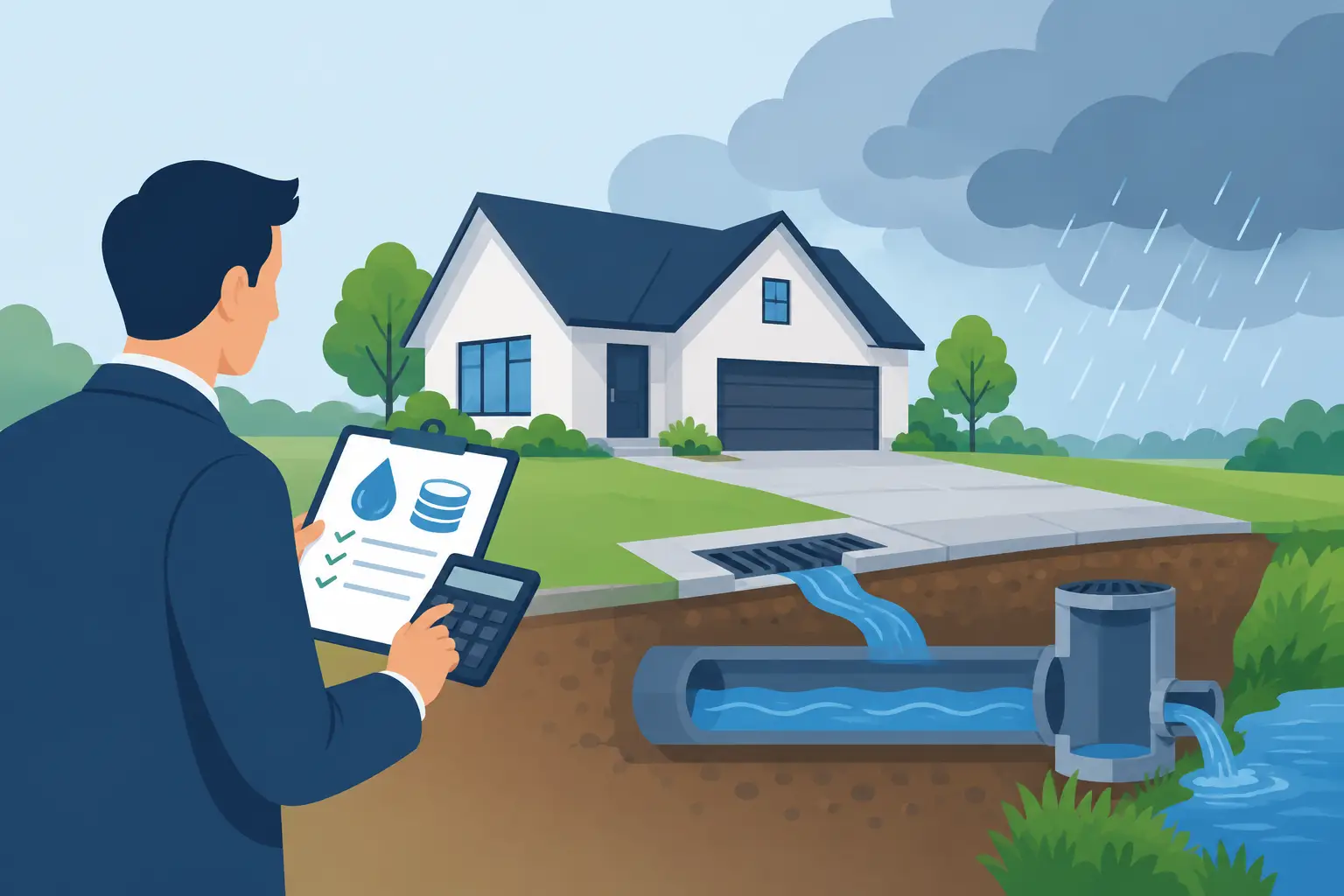
A site can look flat, accessible, and priced right until the drainage plan turns a routine land deal into a six-figure sitework problem. The question is not whether rain falls on the property. It is where runoff goes now, where it must go after development, and what it will cost to control it. Knowing how to assess stormwater costs early gives acquisition and development teams a more defensible land basis before they commit earnest money, engineering fees, or a bid.
Stormwater is not one line item. It is a connected scope that can affect clearing, mass grading, utility conflicts, lot yield, off-site easements, permitting duration, and the construction schedule. A quick number based only on acreage is usually too light. A useful early estimate identifies the likely drainage concept, quantities the major components, and carries contingency where the entitlement and engineering facts are still incomplete.
Start With the Existing Drainage Reality
Before estimating a pond, pipe, or inlet, establish what the site is doing today. Review topography, contours, aerial imagery, FEMA mapping, wetlands, soils, receiving waters, existing ditches, culverts, and nearby development patterns. The goal is to identify the site's drainage direction and the likely discharge path.
Pay close attention to low points and drainage divides. A property that appears to drain toward a road may actually sheet-flow through a neighboring tract, which can create an easement issue. A creek at the edge of the parcel may be an obvious outfall, but it may also bring floodplain limits, buffer requirements, bank stabilization, or agency review. If the site has no viable gravity outfall, costs rise quickly because the project may require additional conveyance, a more complex detention solution, or a pump system in rare cases.
Existing infrastructure matters just as much as natural drainage. Confirm the size, invert elevation, condition, and ownership of downstream culverts and storm systems. An undersized county pipe can limit discharge, force detention volume upward, or trigger off-site improvements. Do not assume that a visible ditch has capacity simply because water is moving through it today.
How to Assess Stormwater Costs From a Concept Plan
A conceptual site plan is the bridge between a site screen and a credible cost range. It does not need final engineering, but it must show proposed impervious area, roads, building pads, open space, likely outfalls, and approximate grading limits. Without those inputs, stormwater pricing is speculation.
Start by estimating the post-development impervious area. Streets, drive aisles, sidewalks, rooftops, parking, and hardscape increase runoff volume and peak flow. For a residential subdivision, the roadway layout, lot count, lot width, and finished-floor assumptions all influence the drainage system. For commercial work, parking coverage and building footprint often drive the problem.
Next, determine which broad control approach the local jurisdiction is likely to require. Depending on the municipality, watershed, and receiving system, the design may include detention, retention, water-quality treatment, conveyance, or a combination. A dry detention basin may be economical where land is available and soils or discharge conditions support it. Underground storage can preserve developable area, but it can materially increase installed cost and maintenance obligations. A wet pond, bioretention area, proprietary treatment device, or infiltration practice may be required based on local standards and site conditions.
At this stage, estimate required storage volume from the governing criteria if it is available. If it is not, use a clearly labeled planning assumption based on similar projects in the same jurisdiction, not a national rule of thumb. Rainfall requirements, release rates, water-quality volume, and treatment standards vary by city, county, and watershed. A Southeast subdivision can have a very different stormwater profile from a site in a colder, more urban market.
Build the Estimate by Scope, Not by One Allowance
A usable stormwater estimate separates the components that create cost. This makes the number easier to revise when engineering advances and easier to defend in an investment committee review.
The major scopes typically include:
- Detention or retention excavation, embankment, grading, topsoil, seeding, and erosion protection
- Storm pipe, structures, inlets, manholes, headwalls, end sections, and outlet-control structures
- Water-quality measures such as forebays, skimmers, media filters, bioretention, or proprietary devices
- Channel improvements, riprap, concrete flumes, bank stabilization, and outfall protection
- Temporary erosion and sediment controls, including construction entrances, silt fence, inlet protection, sediment basins, and maintenance
- Survey, geotechnical investigation, civil engineering, drainage studies, permits, inspection, and long-term maintenance requirements
Quantity takeoff comes before unit pricing. Measure basin cut and fill from terrain data, approximate pipe runs from the concept layout, count structures, and identify outlet distances. Then apply local labor, equipment, material, hauling, and subcontractor pricing. Haul distance can change pond excavation economics dramatically. If unsuitable soils must leave the site or imported fill is needed to build an embankment, a low-cost basin can become a major earthwork item.
For acquisition-stage work, it is often appropriate to carry a range rather than a false-precision total. Separate the base case from the risk allowance. For example, a straightforward basin and pipe network with a known gravity outfall may warrant a narrower contingency than a site with uncertain downstream capacity, wetlands at the only discharge point, and unverified soils.
Watch the Cost Drivers That Get Missed
The basin itself is rarely the entire issue. The most expensive stormwater problems are often created by a constraint outside the pond limits.
Outfall and Off-Site Work
The first question should be: can the project legally and physically discharge? If the answer relies on crossing another property, obtain clarity on drainage rights, existing easements, and the probable cost of acquisition or construction access. Off-site pipe extensions, road crossings, ditch improvements, and downstream upgrades should be modeled separately from on-site drainage.
A developer can have adequate land for detention and still face a bad deal if the only permitted outfall requires a long easement through a neighbor's tract. That is a diligence issue, not a contingency line that should remain vague until closing.
Earthwork Balance and Site Elevations
Stormwater design and grading are inseparable. A basin needs volume, but it also generates excavation. That material may help build pads, road subgrade, perimeter berms, or landscape areas. It may also be unusable due to wet soils, rock, contamination, or unsuitable material classification.
Finished-floor elevations can compound the problem. If floodplain, tailwater, or local freeboard requirements push pads higher, the project may need more fill, longer pipe runs, deeper structures, or reconfigured detention. Evaluate the drainage concept alongside cut-fill balance rather than estimating each discipline in isolation.
Soils, Groundwater, and Maintenance
Do not assume infiltration is free storage. Poorly drained soils, shallow seasonal groundwater, restrictive layers, or contamination can eliminate infiltration practices or require underdrains and amended media. Geotechnical borings and infiltration testing are small costs compared with redesigning a failed concept after land control.
Also account for who owns and maintains the facility after construction. An HOA pond, private commercial facility, or municipal dedication each carries different design standards, access requirements, inspection obligations, and long-term operating exposure. A low initial construction number can be misleading if the solution creates a costly perpetual maintenance burden.
Tie Stormwater Back to the Pro Forma
Stormwater should flow directly into the sitework estimate and development pro forma, not sit in an engineering memo that never reaches the underwriting model. Break the cost into land development categories that let the team see what is moving: earthwork, drainage pipe and structures, basin construction, erosion control, off-site improvements, soft costs, and contingency.
Then test the financial sensitivity. If the drainage scope rises by $300,000, what happens to land residual, margin, levered IRR, or target bid? If the basin consumes two buildable lots, what is the revenue impact in addition to the construction cost? If a permit condition adds six months, what does that do to carry and financing costs? These are acquisition decisions, not just civil engineering details.
A GIS-centered workflow helps because the same terrain, parcel, floodplain, utility, and constraint data used to screen the property can inform quantities, sitework costs, and the pro forma. Land Takeoffs is built around that sequence: evaluate the site, turn terrain and layout assumptions into a contractor-informed estimate, and see the financial consequence before the deal advances.
Set Decision Gates Before Spending More
Early diligence should produce a clear answer about what is known, what is assumed, and what must be verified. For a low-risk site, a desktop drainage review and conceptual estimate may be enough to support a letter of intent. For a constrained tract, make the purchase agreement contingent on civil feasibility, outfall confirmation, wetlands review, and preliminary agency feedback.
Do not wait for final construction documents to discover that stormwater consumes the project's margin. Escalate the work when the potential exposure justifies it: commission a boundary and topographic survey, obtain targeted geotechnical data, have a civil engineer test the drainage concept, and request a contractor review of constructability and unit pricing.
The practical standard is simple: before you buy, know the likely drainage path, the probable control system, the quantities that drive cost, and the assumptions that could still change the deal. A stormwater estimate will never be final at acquisition, but it should be specific enough to tell you whether the site deserves the next dollar of diligence.
Get these quantities from your own plan set
Land Takeoffs reads stamped civil plan sets and CAD files (PDF, DWG, DXF, LandXML) and returns cut and fill, storm, sewer, water and paving quantities, each with the sheet it came from. Your first takeoff is free.
Start a free takeoffUse it in Claude or ChatGPT