Top Erosion Control Cost Factors for Sitework
Top erosion control cost factors can reshape a sitework budget. Price sediment controls, slopes, drainage, permits, maintenance, and closeout before bidding
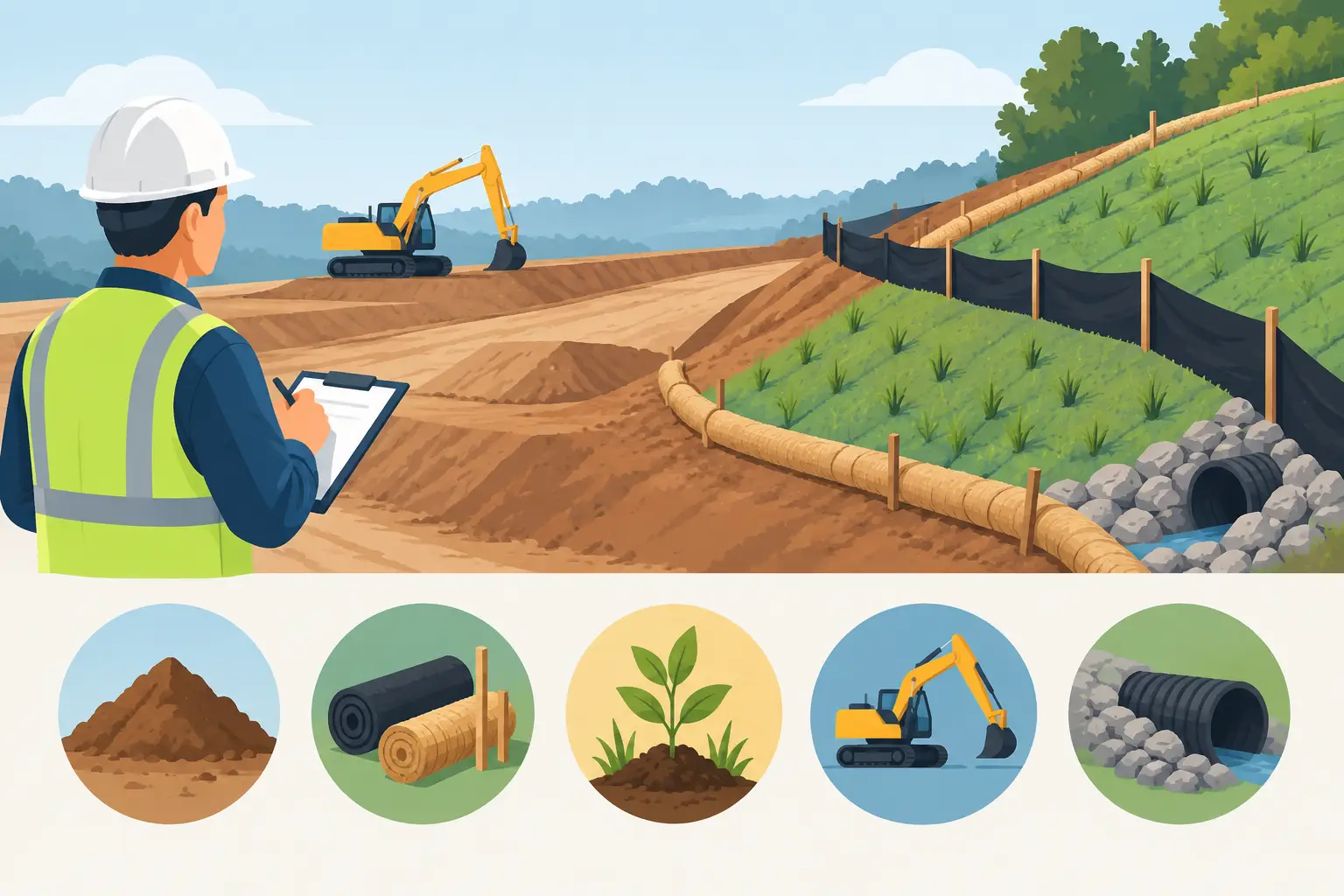
A $30,000 erosion-control allowance can become a six-figure site cost fast when a project has steep grades, off-site discharge limits, wetlands, or a long entitlement timeline. The top erosion control cost factors are not limited to silt fence and inlet protection. They start with the site’s drainage behavior and continue through construction sequencing, inspections, maintenance, and final stabilization.
For developers and sitework teams, the mistake is treating erosion control as a small percentage added after earthwork. It is a construction scope with its own quantities, labor cycles, regulatory exposure, and schedule risk. Price it early enough to influence the deal, not after the civil plans are out for bid.
Top Erosion Control Cost Factors to Underwrite Early
1. Site topography and disturbed acreage
Slope drives both the amount of control required and the reliability of standard measures. A relatively flat infill site may need perimeter silt fence, stabilized construction access, inlet protection, and temporary seeding. A rolling subdivision with long drainage runs may require slope drains, check dams, sediment basins, diversion berms, erosion-control blankets, and phased stabilization.
Disturbed acreage matters just as much as total acreage. A 100-acre tract developed in two controlled phases does not carry the same exposure as 100 acres opened at once. The larger the active disturbed area, the more runoff volume must be managed and the more perimeter, inspection, repair, and stabilization work the contractor must carry.
Early grading takeoffs should identify cut and fill areas, drainage paths, steep slopes, and likely limits of disturbance. That gives the estimating team a way to calculate quantities instead of applying a generic allowance per acre.
2. Soil type, rainfall, and seasonal exposure
Not all exposed soils behave the same way. Fine silts and clays can cloud runoff quickly, while loose sands may erode on slopes and around drainage outlets. Highly erodible soils often require more frequent repair, more aggressive stabilization, and added sediment treatment where runoff leaves the site.
Local weather patterns shape the operating cost. In the Southeast, intense rainfall can damage controls between weekly inspections, particularly during mass grading. A project that breaks ground before a wet season may need heavier temporary measures than one scheduled around predictable dry periods.
This is where low initial pricing can be misleading. A contractor can install the minimum control package at a competitive number, then face recurring mobilizations to repair washed-out fence, replace stone at entrances, clean sediment traps, and restore damaged blankets. The original installation price is only part of the budget.
3. Stormwater design and discharge conditions
The project’s drainage concept is one of the biggest cost separators. If the site can retain and manage runoff internally, temporary erosion controls may be straightforward. If runoff concentrates at a few outfalls, crosses adjacent property, enters a regulated stream, or discharges near public infrastructure, the temporary system needs more capacity and closer monitoring.
Sediment basins, traps, dewatering systems, flocculant treatment, temporary piping, and outlet protection can materially change the sitework estimate. So can the need to protect existing roadside ditches, downstream ponds, culverts, or municipal storm systems.
Review the civil concept alongside available GIS layers, FEMA mapping, wetlands, streams, contours, and utility corridors. These constraints do not replace engineering, but they can flag whether the project is likely to need a basic perimeter-control package or a more involved stormwater operation.
4. Permit requirements and inspection frequency
Erosion-control rules are local in their enforcement even when the permit framework is familiar. County and municipal requirements may prescribe inspection intervals, reporting formats, stabilized entrance standards, basin specifications, or specific controls near waterways. Some jurisdictions are practical. Others inspect aggressively and expect immediate correction.
Budget for the paperwork and field management, not just materials. The responsible party may need routine inspections, rain-event inspections, logs, photos, corrective-action tracking, and coordination with the owner, civil engineer, and superintendent. On a long-duration project, that labor can exceed the original cost of several installed measures.
Permit risk also has a schedule value. A stop-work order, failed inspection, or delayed correction near paving or vertical construction can cost far more than installing a stronger control at the start. The right scope depends on jurisdiction, but a thin allowance is rarely a smart underwriting strategy.
5. Construction phasing and project duration
Erosion control is temporary by definition, but temporary does not mean short-lived. A site that is exposed for 18 months requires a different budget than a site stabilized in six months. Delayed utilities, phased lot releases, financing changes, and slow absorption can all extend the period when controls must remain functional.
Phasing can reduce costs when it limits exposed soil and allows completed areas to be stabilized before the next phase starts. It can also increase costs if crews must repeatedly install, remove, relocate, and re-establish controls as work moves through the property.
The estimate should separate initial installation from recurring maintenance and final removal. That structure helps acquisition teams see the cost of a longer development schedule rather than burying it inside one erosion-control line item.
6. Access, haul routes, and public-interface protection
The public edge of a project creates cost and liability. Mud tracking onto public roads requires stabilized construction entrances, periodic street sweeping, and replacement stone. Work near occupied homes, schools, retail centers, or public roads may require extra signage, traffic coordination, inlet protection, and faster cleanup response.
Haul traffic can destroy temporary controls as quickly as rainfall. If trucks cross drainage swales, use narrow access points, or travel over soft ground, the site may need reinforced crossings and frequent maintenance. The cheapest entrance detail is not always the least expensive option once cleanup, complaints, and inspection failures are included.
7. Materials, labor availability, and maintenance response
Silt fence, wattles, riprap, stone, blankets, seed, and temporary pipe are common materials, but local pricing still moves with demand and hauling distance. Labor availability matters even more when a weather event creates simultaneous repair demand across a market.
Ask who owns the maintenance obligation and how quickly they can respond. A low bid that excludes rain-event repairs, sediment removal, replacement materials, or emergency mobilization is not comparable to a bid that includes active maintenance. Scope language should state what is included, what triggers extra work, and who carries disposal costs when traps or basins need cleaning.
Build a More Defensible Erosion-Control Budget
A useful erosion-control estimate starts with quantities and operating assumptions. Measure perimeter length, drainage features, access points, disturbed acreage, slopes, outlet locations, and areas requiring temporary or permanent stabilization. Then price installation, recurring inspection and maintenance, sediment removal, repair allowance, and final closeout separately.
For larger land plans, use at least three scenarios. A baseline case can assume normal installation and routine maintenance. A wet-weather case should carry additional repairs, cleaning, and response time. A constrained-site case should account for sensitive outfalls, steep slopes, adjacent development, or demanding jurisdictional requirements. This does not create false precision. It gives the team a realistic range before land basis and returns are locked.
Land Takeoffs can help teams move from terrain and site constraints to line-item sitework assumptions in the same analysis used for the development proforma. The point is not to replace the civil engineer or erosion-control contractor. It is to identify cost exposure before the deal depends on an optimistic placeholder.
What to Ask Before You Accept a Low Allowance
A low erosion-control number deserves a scope review, especially when it is materially below competing bids or historical costs. Ask whether the price includes basin excavation, outlet protection, stabilized entrances, inspections, rain-event repairs, sediment disposal, temporary seeding, and final removal. Also confirm the assumed project duration and disturbed acreage.
The answer may be that the site is simple and the low number is justified. But if the scope is incomplete, the savings only exist on paper. Erosion control is one of the first field scopes on a project and one of the last to disappear. Price it like an operating requirement, then let the site conditions decide how much contingency the deal needs.
Get these quantities from your own plan set
Land Takeoffs reads stamped civil plan sets and CAD files (PDF, DWG, DXF, LandXML) and returns cut and fill, storm, sewer, water and paving quantities, each with the sheet it came from. Your first takeoff is free.
Start a free takeoffUse it in Claude or ChatGPT